
Man, I sure write about Van Halen and its alums quite a bit on this blog. And why not? The band is never short on drama.
We’ve looked at the disastrous Gary Cherone-fronted Van Halen III. We’ve looked at David Lee Roth’s solo career. We’ve looked at Roth’s return to the band (multiple times, as it turns out).
We haven’t covered Sammy Hagar’s tenure as frontman very much.
Well, that changes now. Right now!
When Sammy Hagar joined Van Halen in 1985, replacing David Lee Roth as lead singer, he first had to make a deal with David Geffen.
He had joined Geffen’s label in 1981 and released some of his best-known songs there, including “I Can’t Drive 55” and “Your Love Is Driving Me Crazy.” When Hagar expressed his desire to join Van Halen (who were on rival label Warner Bros.), Geffen agreed on the condition that he record one last studio album for them.
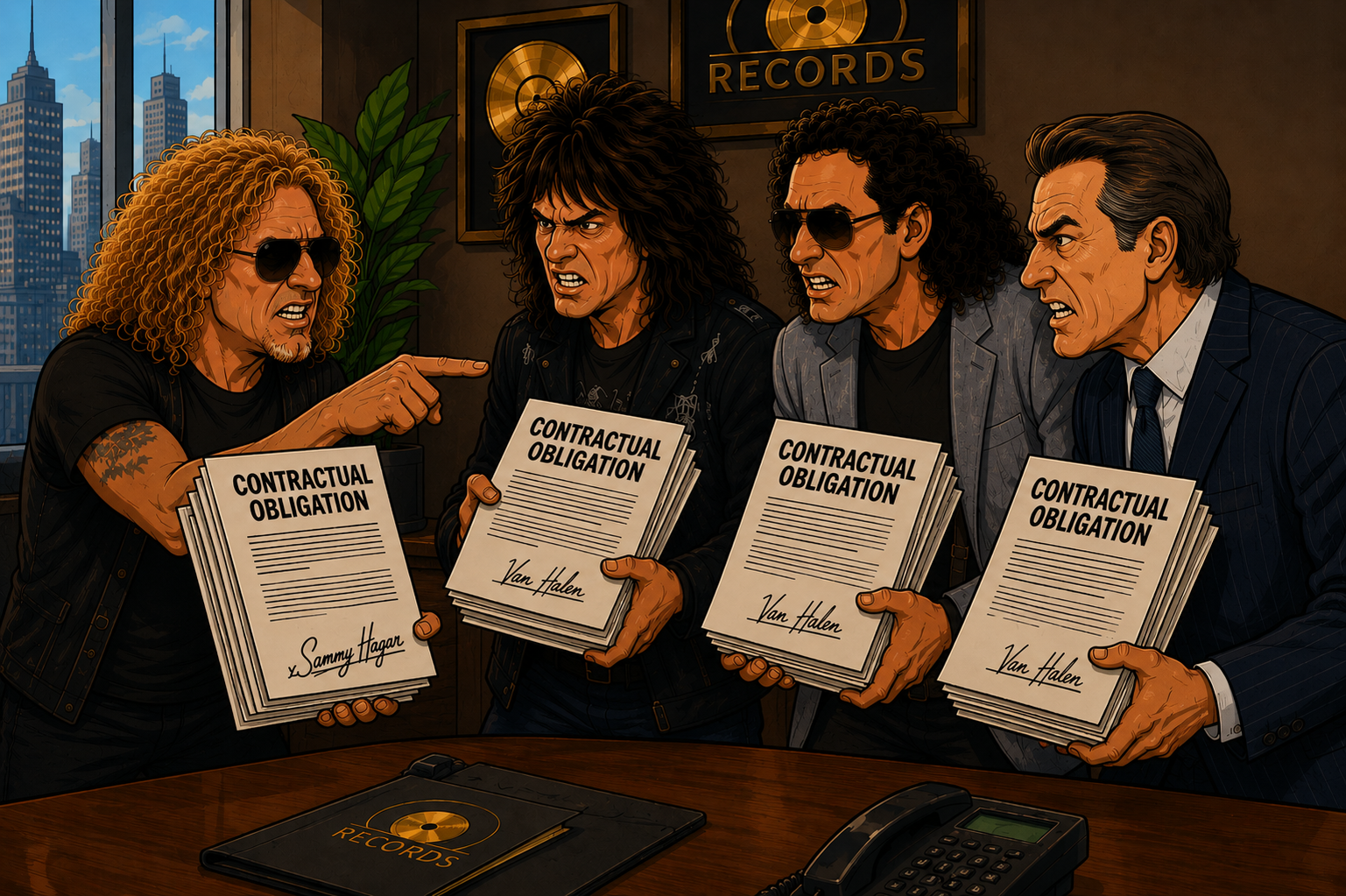
So after Van Halen wrapped up its tour promoting 5150, its successful debut album with Hagar, The Red Rocker made a quick trip to the studio to fulfill his contractual obligation.
There was even some Van Halen synergy involved, as Eddie played bass and co-produced the album. Two songs from the album would even find their way onto VH set lists on subsequent tours: “Eagles Fly” (featuring an Eddie guitar solo) and “Give to Live.”
But otherwise, it was very much a rush job that was primarily designed to fulfill Hagar’s old deal as quickly as possible. Hagar certainly didn’t seem to put much effort into it, recording the entire album in 10 days, and not even bothering to give it a title. Instead, he partnered with MTV to sponsor an album-naming contest (“I Never Said Goodbye” ended up winning).
Hagar has since said that he loves this album and had a blast recording it. Still, it wasn’t going to deter him from his primary goal of being in Van Halen. It also didn’t mean he was going to pull a Phil Collins and juggle a solo career alongside his commitments to the band — something he was allowed to do per his contract with Van Halen. A “Best of Both Worlds” clause, if you will.
Instead, Hagar concentrated on the band, and things went really well for the next few years. Van Hagar (as some fans and critics have referred to this incarnation of the band) actually experienced more chart success than the Roth-led incarnation, with albums 5150 (1986), OU812 (1988), For Unlawful Carnal Knowledge (1991) and Balance (1995) all hitting #1 on the Billboard 200. (They even became part of the zeitgeist by licensing “Right Now” for Crystal Pepsi — a drink I liked but almost no one else did.) By contrast, the band’s highest-charting albums under Roth were 1984 and A Different Kind of Truth (2012), which both hit #2.
Despite that, the Roth Era albums significantly outsold the ones from Hagar — 57 million to 27 million worldwide. But there is a caveat. Under Roth, the band churned out 6 albums in 6 years (before releasing a 7th album many years later during their reunion), a breakneck pace that kept them working constantly and surely burned them out.
Van Hagar took more time between releases, putting out 4 albums in 10 years together. The differences are clear. The Hagar albums are longer and rely solely on original material while the Roth albums tended to run barely over 30 minutes and almost always included a cover or two.
Whether or not you believe this means the Hagar stuff was better or of higher quality probably depends on how you viewed the Roth era. If you thought Diamond Dave was a Golden God who single-handedly gave the band its swagger and attitude, then you probably bemoaned the sincerity and AOR stylings of Van Hagar. If you thought Roth was a blowhard who could barely sing, then you probably welcomed Hagar’s vocal capabilities and his more varied songwriting.
Nevertheless, both singers have their merits (and limitations) and both incarnations of the band have sizable fanbases. And some fans even love both of them and would have given anything to have seen a massive Van Halen reunion tour featuring both Roth and Hagar (probably not Cherone, though).
In any event, Van Hagar started to splinter right during the period between For Unlawful Carnal Knowledge and Balance. It should have been a triumphant moment for them — unlike many of their hair metal brethren, they had seemingly survived the onset of grunge and looked set to continue their dominance into the 00s and beyond.
But a series of contract disputes tore at the fabric of the band. In 1993, Geffen informed Hagar that it would be releasing a compilation of his greatest hits from his time as a solo star at the label. They were allowed to do so, as “greatest hits” clauses are routine parts of almost all recording contracts. For instance, Capitol Records, his label before moving to Geffen, had released several compilations over the years — all without Hagar’s involvement or authorization.
Geffen, however, wanted Hagar to be involved with the project and threw in a sweetener. In exchange for recording two new songs and doing some promotion for the compilation, Geffen would pay Hagar $500,000. Ordinarily, Hagar would have said “no,” but he was going through a divorce at the time and saw an opportunity to pay off his soon-to-be ex-wife. So after getting the price tag to $750,000, Hagar said “yes.” He ended up recording two songs that had been rejected by Van Halen: “High Hopes” and “Buying My Way Into Heaven.”
Hagar recalled that the band’s manager at the time, Ed Leffler, had told him that Eddie and Alex Van Halen might have a problem with him pursuing a solo project while in the band. Unlike what happened with I Never Said Goodbye, this was Hagar deciding to do a solo project without being forced to do so since he could have just let the greatest hits package come out without his involvement. Eddie and Alex were always touchy about people doing things outside of the band (Roth’s departure had been primarily due to disputes over his solo projects), so this was sure to rattle their cages.
Nevertheless, Hagar wasn’t concerned and figured Leffler would smooth things over with the brothers. That’s what good managers do, after all. But then Leffler, who was suffering from cancer, died.
Without Leffler to mediate, both sides (neither of whom were very good at communicating with the other) assumed the worst. The brothers thought Sammy was going to dump them and go solo and Hagar thought they were being insensitive to his financial and marital situation.
They didn’t want me to do the album. I told them I was going to do it and that it was going to pay for my divorce. They argued and argued. They said it would be bad for the band. It wasn’t like they said anything before to my face. They were real behind-the-back guys. They had a couple of conversations, worked each other up, started freaking out, and began to look into ways to keep me from doing something I wanted to do.
Sammy Hagar, Red: My Uncensored Life in Rock, 2011
Later on, Hagar would reflect that he considered the greatest hits kerfuffle to mark the beginning of the end of his time in the band. “If I would have ever dreamed that I wouldn’t be in Van Halen anymore and was going to have to resume my solo career again, I would have never contributed anything towards my own greatest hits package, even for the money,” he said in an interview with Guitar World. “I would have just taken the money out of my bank account and paid my wife rather than work on the project.”
Meanwhile, the question of whom to hire to replace Leffler proved to be an even bigger point of contention. The brothers wanted Ray Danniels, Rush’s longtime manager and the man who happened to be Alex’s brother-in-law. Sammy, on the other hand, wanted — not Ray Danniels.
“He didn’t do shit for me. He wasn’t my manager. I would find my own manager. I did not like the guy. I wanted to bite his face off,” Hagar recalled in his autobiography. (Hagar said some even worse things in a couple of leaked chapters of a book whose publication he later sued to halt).
Mostly, Hagar didn’t trust Danniels and believed he was trying to drive a wedge between him and the brothers. According to Hagar, Danniels was telling the Van Halens that Hagar and Leffler had cheated them out of money and was whispering to Eddie that he should be the one calling the shots, not Hagar.
“The quote was from the manager: ‘Eddie wants his band back,’” Hagar said in a 2015 interview with Opie & Anthony. “I mean it’s been a long time. Dave ran that band then I ran that band.”
Ultimately, Hagar refused to sign a management deal with Danniels. He also found out that the clause in his Van Halen contract allowing him to do solo albums had been mysteriously removed. So, once again, contracts had reared their ugly heads and added to the tensions between Hagar and the brothers.
Meanwhile, at around the same time this was happening, the three got into a business dispute over a cantina they had bought together in Cabo San Lucas. The cantina, named “Cabo Wabo” after the OU812 song, wasn’t doing well and the brothers wanted out. Hagar wanted to stick it out, so he agreed to buy them out. He even worked with Danniels to come up with a deal whereby the brothers would write off their losses on their taxes and have the right of first refusal if Hagar decided to build another cantina. Hagar also had to indemnify them, essentially agreeing to take the legal hits for them in case anything happened — which seemed likely since the bar looked set for bankruptcy.
Sure enough, the bar started doing well under Hagar’s stewardship and the brothers felt cheated. “The brothers weren’t happy. They started accusing me of running the place into the ground so that they’d give it back to me. I wish I were that smart,” Hagar said in his autobiography.
Thanks in large part to all of these contractual disputes, sessions for Balance were fraught with tension and Hagar later recalled that he and Eddie fought over things they never had before, including Hagar’s lyrics.
“I knew they were trying to get rid of me. Eddie was trying to make me quit. He would find something wrong with every lyric I’d write. He’d never said a word about a lyric before. Suddenly he didn’t like anything,” Hagar wrote in his autobiography.
Nevertheless, they completed the album and got through the tour in one piece. But when it was time to figure out what to do next, things fell apart.
This time, the Van Halens and Danniels wanted to take advantage of the greatest hits clause in their recording contract and release a compilation along with some new songs. They also wanted to do two new songs for the 1996 film Twister.
Hagar was against both moves. According to him, the band was supposed to take some much needed time off in 1996 — Eddie was battling a hip problem and Alex had an old neck injury he was supposed to get surgery on (live videos from this era almost always showed him wearing a neck brace on stage while drumming). Hagar, meanwhile, had remarried and was expecting his first child with his new wife and wanted to spend time with his soon-to-be expanding family.
He also felt the band didn’t need to release a greatest hits compilation yet and that they still had another good album or two before they needed to consider that route. That opened him up to accusations of hypocrisy from the brothers, who were upset since they had agreed to Hagar’s request to record new songs for his compilation a few years prior.
Nevertheless, Danniels and the brothers agreed to do the songs and threatened Hagar with expulsion if he didn’t show up. When he did show up, things were tense, as he and Eddie fought constantly over the former’s lyrics for the Twister songs. Ultimately, Hagar recorded “Humans Being” and “Between Us Two,” and then rushed home so he could be with his wife. When the latter was rejected by the director, Hagar refused to come back and do more work on the song, forcing Eddie and Alex to record an instrumental track that ended up on the soundtrack (“Respect the Wind”).
He also refused to work on any songs for the greatest hits project, going so far as to tell Eddie to “f— himself” when the guitarist gave him an ultimatum to show up or they’d assume he was out of the band. When Hagar didn’t turn up, Eddie put his money where his mouth was and called Roth, who had limited career options at that point and jumped at the chance to reunite (kind of).
Eddie then fired Hagar over the phone on, ironically enough, Father’s Day in 1996, twisting the knife further by telling him Diamond Dave was back. Eddie later claimed Hagar quit because he wanted to be a solo artist again and he and his brother questioned his commitment to the band because of his unwillingness to record the new songs. “The bottom line, his work ethic sucked, okay?” Eddie told MTV News in 1996. “If he wanted to be in this band and be a team player, he’d be here right now.”
He also added in an interview with Guitar World that Hagar didn’t want the greatest hits album because he was afraid of being compared to Roth. “I said “Wait a f—‘ minute, Sammy. This band has been putting out records for 20 years and never put out a greatest hits-but you already have two of them.’ It just goes to show that, in his mind, he was always a solo artist–once a solo artist, always a solo artist. He was only into being in Van Halen for the prestige of it,” Eddie said to Guitar World.
Hagar disputed that and said he was fired for wanting to be there for his pregnant wife. He also pointed the finger at Danniels, noting that another one of his clients, a Boston rock band called Extreme, had just split and its singer, Gary Cherone, was looking for a new gig.
Either way, the band had entered a very dark, unstable and turbulent era where things seemed to go wrong much more than they ever came close to going right. Eddie had emerged largely unscathed in the court of public opinion when Roth had first left (let’s face it, Roth definitely seems like the type of person you’d want to kill after being around for the better part of a decade, so the fact that Eddie didn’t was probably a credit to him). But after slagging off Hagar, people started wondering why it always seemed to be the singer’s fault.
Plus, now, he finally had the power he had always wanted. So when he used that power to create Van Halen III, people started wondering if maybe he had been the problem all along.
Then came the absolute nadir. After parting ways with Cherone and secretly giving it a go with Roth one more time, Hagar agreed to reunite for a tour in 2004, as well as to record three new songs for another greatest hits collection.
According to Hagar, Eddie was deep in substance abuse at the time and was barely functional, both on and offstage. In his autobiography, Hagar recounted how difficult it was to record songs they could have once banged out in a couple of hours.
Hagar also noted that, when it came time to rehearse the older songs, Eddie often made mistakes or barely put forth the effort. At one point, Hagar, new manager Irving Azoff (Danniels was no longer in the picture), and some others tried to stage an intervention only for Eddie to reportedly say: “I will kill the first motherf—- that tries to take this bottle away from me. I left my family for this shit. You think I’m going to fucking do this for you guys?”
Eddie also tried to get bassist Michael Anthony excluded — even though it was a reunion tour. Hagar said he wouldn’t tour without Anthony and the bassist ultimately signed a reduced-royalties deal and agreed to leave the band afterwards.
During the tour, old grudges resurfaced. According to Hagar, the Cabo Wabo thing was still a point of contention and Eddie banned Hagar from plugging the club. Hagar responded by getting a big tattoo of the logo on his arm and making sure he wore sleeveless shirts on stage.
After an incident where a drunken Eddie tried to smash out a plane window during a flight, Hagar tried to walk away from the tour. But, in another recurring theme here, the contracts had pretty onerous clauses for doing something like that, so he decided to stick it out so he wouldn’t get sued to oblivion.
Ultimately, the band did the thing that all groups do when they’re feuding but can’t get out of their tour commitments: they had separate planes, buses and hotels so that Hagar and Anthony didn’t have to see the brothers until it was time to go on stage.
And when they got on stage, things only got worse. The shows went terribly, as Eddie, by most accounts, played poorly and made a lot of uncharacteristic mistakes. The tour did well financially, and as Hagar later pointed out, the band actually made all of their tour dates and didn’t have to cancel any shows.
But those were the only silver linings. Once the tour ended, Hagar and Anthony left the band and never worked with the Van Halens again. A few years later, the brothers reunited with Roth, only this time with Wolfgang, Eddie’s son, on bass instead of Anthony. Somehow, that lineup ended up being fairly stable and would last until Eddie’s death in 2020. Meanwhile, Hagar and Anthony forged ahead, forming their own VH tribute group with Joe Satriani and Kenny Aronoff.
And there’s still plenty of drama between the surviving members. Alex Van Halen wrote a book that focused almost entirely on the Roth years to the near-exclusion of the Hagar and Cherone years. “What happened after Dave left is not the same band,” Alex told Billboard. “I’m not saying it was better or worse or any of that.”
Hagar took offense to that and speculated as to why Alex still holds a grudge against him after all these years. Maybe it was over Hagar airing their dirty laundry in his book. Maybe it was loyalty to Roth. Or maybe it was due to an old grudge that never went away.
And some people have said to me, “Oh, Cabo Wabo. At one time, Van Halen, when you built it, you guys were all partners in that. And then they didn’t want it anymore when it was losing money, and they gave it to you, and you turned it around and made hundreds of millions of dollars on it. And they’re angry. Alex is angry about that.”
Sammy Hagar, Rolling Stone interview, April 2025.
That’s not all. Alex and Dave were at odds over a potential reunion/tribute tour. Sammy and Dave still don’t like each other very much. Even Wolfgang and Dave exchanged words, for some reason.
It wouldn’t be Van Halen without the drama. Maybe that’s also in the contract.
