
There have been several multi-one-hit wonders in the U.S., where an artist had one song reach the Top 40 of the Billboard Hot 100 as a member of a band and then had another such hit as a solo act or in a different band.
For instance, Kajagoogoo had a smash hit in 1983 with “Too Shy.” They then parted ways with their frontman, Limahl, who went solo and had a hit the following year with the theme song to The NeverEnding Story.
A couple of years later, the Georgia Satellites hit #2 on the Billboard Hot 100 with “Keep Your Hands To Yourself.” Their lead singer, Dan Baird then managed a hit six years later with “I Love You Period.”
Perhaps most famously, Everlast rapped the lead vocals for House of Pain’s 1992 era-defining hit “Jump Around.” He then went in a completely different direction, reaching #13 in 1998 with the bluesy, acoustic-based “What It’s Like.”
There are several others — like Eddy Grant, Norman Greenbaum, Rick Derringer, and J.D. Souther. Paul Rodgers of Bad Company fame, had one hit with two other groups: Free and The Firm. Meanwhile, proficient U.K. session musician and singer Tony Burrows ended up performing on five one-hit wonders.
There have also been some who were big in other countries but only had limited chart success in the U.S. — like Bryan Ferry/Roxy Music. Gary Barlow comes close, as he had one hit in the U.S. with Take That (“Back For Good”) and then a solo single that just missed the Top 40 (“So Help Me Girl”). His Take That-bandmate, Robbie Williams, is also disqualified, but for the opposite reason. He actually had two singles that broke the Top 40 in the U.S. (“Millennium” and “Angels”).
And, of course, there was Jamie Walters. The handsome actor with a golden voice had the tools and platform to become a superstar— not a double one-hit wonder. But becoming the Ike Turner of the Beverly Hills 90210-verse stopped his career dead in its tracks.
It’s 1994 and Jamie Walters has just landed the role of a lifetime.
He’s been cast on the hit Fox show Beverly Hills 90210 as Ray Pruit, a rising singer-songwriter and heartthrob from the other side of the tracks (just to hammer home that point, he introduces himself as “Pruit with one ‘t’ ‘cause that’s all my momma could afford”). He strikes up an unlikely romance with Donna Martin (Tori Spelling), a college student who hails from a wealthy and prominent family.
At first glance, Walters and 90210 seemed like a match made in heaven. He had already demonstrated his bonafides as an actor and singer, having starred in Shout, a 1991 film that was released during John Travolta’s first (and less successful) comeback in the 1990s. In what would become a trend during his brief career in Hollywood, he played a rock singer — in this case, he was a student in a boys’ reform school who was inspired to become a musician by Travolta’s character — a mix between Kevin Bacon in Footloose (bringing rock music to his environment, in his case, the reform school) and Robin Williams in Dead Poet’s Society (inspirational teacher who rebels against the school he teaches at). I remember seeing the trailer for that movie and thinking it was going to be great (of course, I also thought that about Pearl Harbor — never trust a trailer). Instead, the movie bombed and got savage reviews — nowadays, it’s remembered more as Gwyneth Paltrow’s film debut, as well as one of Heather Graham’s earliest roles.
Walters wasn’t scathed, though. He was cast as the lead in 90210-creator Aaron Spelling’s musical drama series, The Heights, which aired in 1992 on Fox. Unlike Melrose Place, which was a spin off of 90210, The Heights did not have any connection to the 90210-verse, sparing us any confusing questions like “was Alex O’Brien (Walters’ character in The Heights) actually the same person as Ray Pruit?”
The show chronicled the trials and tribulations of a rock band consisting of seven working-class young adults — some of whom looked like they stepped off the pages of Tiger Beat. The cast members actually sang on the soundtrack, with Walters singing lead on the show’s big hit and eventual theme song, “How Do You Talk To An Angel.” (He also dated and got engaged to Drew Barrymore at around this time — that didn’t last.)
The song reached #1 on the Billboard Hot 100 in November 1992, ending the historic 13-week reign of Boyz II Men’s “End of the Road.” It would stay at the summit for two weeks before giving way to another song that made history: Whitney Houston’s “I Will Always Love You,” which set a new record of 14 weeks at #1.
Unfortunately for The Heights, the success of the song did not extend to the show. Less than a week after “How Do You Talk To An Angel” fell from the #1 spot, Fox cancelled The Heights after 12 episodes. “I got two phone calls back-to-back. The first phone call was ‘hey, your song went to #1,’ and I was like ‘cool,’ and hung up the phone,” Walters recalled to VH1. “Then, ring ring, I pick it up, ‘uh, your show’s cancelled.'”
“It’s very strange to have the record explode,” Spelling told The Hollywood Reporter. “I guess this is the cart pulling the horse. We went in with the other thing in mind. We thought the show might help the record.”
Walters landed on his feet, though, signing a record deal and starting work on his self-titled debut album. He even re-teamed with two of the songwriters behind “How Do You Talk To An Angel,” co-writing lead single “Hold On” with them. The album also featured a song he co-wrote with Zachary Throne, his Heights co-star.
At around the same time, Spelling decided his flagship series, Beverly Hills 90210, needed a change of pace. He wanted a character who was different from the rest of the rich kids and could cause conflict — both from a personal and socioeconomic standpoint — but not too different that he couldn’t eventually fit in with the group and become their friend (it probably helped that Walters, like 90210 stars Jason Priestley and Luke Perry, was also a good looking guy with light-brown hair and sideburns).
So, he came up with Ray Pruit and cast Walters in the role. To sweeten the pot, they modeled the character after him. “They were looking for someone who could sing to bring something different to the show. I’m lucky because I get to sing my songs,” he told The Toledo Blade, adding that he liked his character since he was the “most real of anyone on the show.”
And, since he had an album out at the time, being on the show would allow him to promote his music on network TV — a big deal at the time. Indeed, his lead single, “Hold On,” was released on October 11, 1994 — shortly after he made his debut midway through the fifth season of 90210 (Ray even performed an acoustic version of the song shortly after being introduced on the show).
That synergy immediately paid off, as “Hold On” became a big hit, peaking at #16 on the Billboard Hot 100. With Walters performing additional songs throughout the season, it seemed a matter of when, not if, he would get another hit off his album.
But then his character arc really kicked in and that’s where things started falling apart. You see, Ray’s character was meant to bring conflict, and he did plenty of that. He was often at odds with Donna and her friends — he saw them as superficial and shallow, they saw him as beneath Donna and didn’t understand why she was “slumming” with him. There were moments his character worked well on the show, especially when he would make good points about Donna and her friends not understanding how the real world worked because they were isolated in their wealthy little bubble and how they could be extremely judgmental and hypocritical — all common complaints about the characters from fans and critics over the years.
If that had been the end of it, then things would have been fine. Instead, he also brought physical conflict. Ray started abusing Donna, at first verbally and emotionally. He tried to isolate her from her friends and would lash out at her whenever he felt like she wasn’t paying him enough attention. Soon enough, it became physical. He threw her against a wall at one point and then, most infamously, he shoved her (obvious stunt double) down a flight of stairs.
At first, Walters seemed intrigued to play a domestic abuser. “It’s a serious issue — I can’t take it lightly,” he said in a 1995 interview on AOL. “I hope people in the world who are suffering from abuse will feel a connection with it and it sparks conversations with other people that will help them get through their problems.”
Later on, he admitted (perhaps with the benefit of hindsight) that he had been uneasy about the storyline, but Aaron Spelling, himself, convinced him to do it. “He was like, ‘We think this is a really interesting direction for your character because it’s going to bring up some really important topics about domestic abuse’ and all this stuff. And I’m like, ‘Okay, uh, I’m not sure how people are going to receive that,'” Walters told The Sun in 2024.
Plus, he had been promised that the show would get into some of the reasons why Ray did what he had done and that there would be a big redemption angle for him. “I think people are going to understand why he’s the way he is and realize he’s not so bad. By the way, I also think the audience gets sick of people who are so *nice* on TV — every once in awhile you have to throw ’em a curve ball,” he said in the AOL interview.
In fact, 90210 writers have confirmed that there was a planned rehabilitation arc for Ray. “We had this whole plan. He was going to go to rehab because he was an abused child. We were going to redeem him because we liked him. He was a wonderful kid. Jamie was a dear guy. We liked him. He was a great worker,” writer-producer Larry Mollin said in an interview.
But then Aaron Spelling changed his mind. According to Mollin, Spelling was getting tons of letters from fans along the lines of “how could Donna be so dumb to be with this guy?” and ordered them to write Ray off the show. Mollin even revealed that Spelling made it clear he was protecting his daughter’s reputation, saying: “You have to get rid of him. Everyone thinks Tori’s stupid.”
“We had just signed him for a million dollars, but he got to walk away with his money. But it was still devastating for him. We left him as being a beater, which stayed with him, unfortunately. People thought he was a beater. It was just terrible. I just always felt really bad about that. It just didn’t work out well,” Mollin said in the interview.
He was abruptly written out in the middle of season 6, leaving town to go on tour with his band. He did come back later that year for a guest spot where they tried to hastily rehabilitate him by having him make up with Donna and talk about how he was in therapy for his anger issues. But by then, the damage was done.
It’s especially rough since, by all accounts, Walters is a pretty nice guy in real life. His cast mates all praised him for his work on the show and Tori Spelling later said that Ray becoming abusive and throwing her down the stairs was her only disappointment on the show since she and Walters had become such good friends.
“I think back then, it was a harder time for the public to differentiate between the two — the character and the actor,” Walters said in 2009 to Entertainment Weekly. “These days, you have the internet, and people are much more aware that you’re an actor because they know everything about your real life, too. Back then, people weren’t so accessible.”
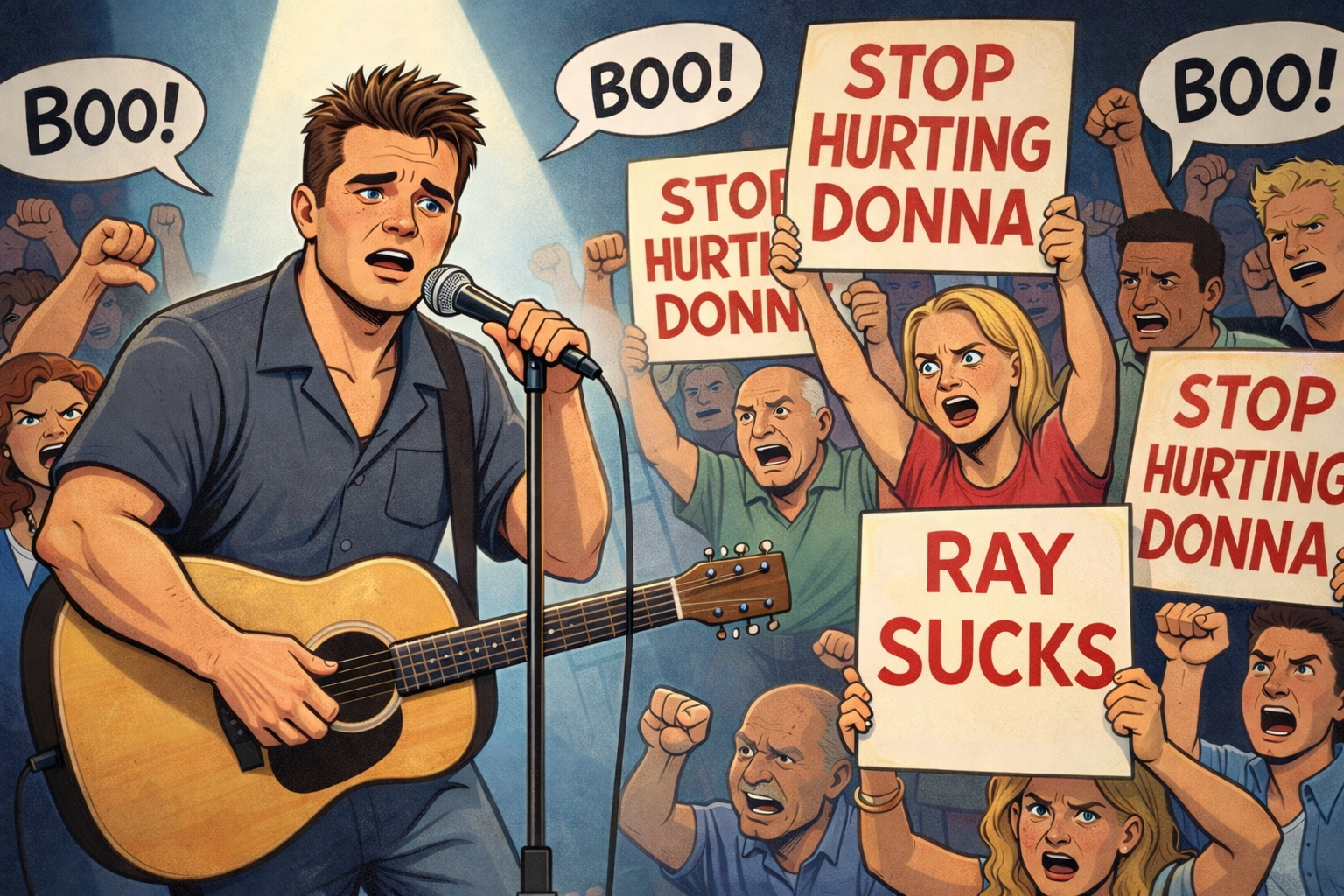
Walters said he started getting hate mail and would often get stopped in public by angry fans, demanding that he stop abusing Donna. And when he went on tour to promote his album, he said some fans even picketed his shows. “I’m going out and trying to sell tickets on our tour, and there’s teenaged girls who really think I’m an abusive guy, and they hold up signs saying like ‘leave Donna alone.’ That was so not what I wanted,” he recalled to MTV.
Leaving the show proved to be a double-edged sword. While he no longer had to worry about playing Ray Pruit, he had lost his main vehicle for promoting his music. His second album, 1997’s Ride, was a failure since, according to him, the label did not know what to do with him at that point. “If I wasn’t on TV and providing them with tons of promotion and exposure, the record label was like ‘hmmm, he’s not the cash cow we thought he was,'” he said in the same MTV interview. He did get to perform one of his songs off Ride when he returned to 90210 as a guest star in 1997, but it didn’t seem to help. Unlike what happened the first time around, Ride flopped and none of its singles charted.
His acting career also stalled. According to IMDB, he’s only had a handful of roles since 90210 — one of them was in the weird 2019 BH90210 reboot/mockumentary in which he appeared as himself and played “How Do You Talk To An Angel” at a bar with the gang in attendance. In the scene, Walters told Tori Spelling that the show ruined his acting career and that he became a firefighter.
And that’s pretty much what happened. Walters has been a firefighter and paramedic ever since leaving Hollywood behind. He’s made a few forays back into acting, mostly in reality shows and “Where Are They Now?” type of programs. He also recorded one more album, releasing Believed on an independent label in 2002. Other than that, he’s been focused on living his life away from the spotlight, raising his four children and doing his job. He did tell Entertainment Weekly that he still gets recognized from time to time, and once he had a call where he had to treat a woman complaining of chest pains. The woman called him “Ray” and asked him why he had been so mean to Donna.
And that’s why he was never able to shake off that scene. Much like how Laurence Fishburne was a little too good as Ike Turner in What’s Love Got To Do With It? (like Walters, Fishburne says women would look at him funny whenever they saw him in public for years after that role), Walters became so singularly identified with that role that he was never able to get past it. Unlike Fishburne, who was able to move on thanks to other performances and roles, Walters never really got any other parts — at least none as big or as well-known as Ray. It’s hard to escape your biggest role when you have nothing to compare it against.
Another reason why the role was so identified with him was because that was the original point. They wanted a singer and Walters fit the bill. The fact that Ray exclusively sang Jamie Walters’ songs (there were some episodes that even ended early so they could show Walters’ music videos at the end), reinforced the notion that they were one and the same. He wasn’t the only one on the show who experienced that. Shannen Doherty’s off-screen bad behavior ended up affecting how fans saw Brenda, with “I Hate Brenda Walsh” newsletters popping up during her time on the show.
Also, Walters was fairly limited as an actor and often came across as pouty or whiny — even in scenes where he wasn’t supposed to be either. As such, some of his best scenes from an acting standpoint, at least where we got to see the most range from him, tended to be the violent or abusive ones.
But perhaps most importantly, it wasn’t just about what he had done but whom he had done it to. Donna wasn’t just the creator’s pet — her character functioned as the moral compass of the show, and in some cases, she served as surrogate for the audience. She was the reasonable one who called out both Kelly and Brenda when they fought over Dylan. She was the good one who didn’t cheat on her boyfriends and, for a while, was waiting until marriage to lose her v-card. She was the non-judgmental one, dating Ray despite his lower economic status and nearly dating DeShawn, a Black college basketball player, despite her mom’s disapproval. She was the kind soul who tried to see the good in everyone and was always nice and friendly, causing more than one stalker to become obsessed with her. As fans have pointed out, she never really did anything bad to anyone else — bad things happened to her. And while the rest of the gang had obvious flaws, Donna did not — at least not after they left school. Brandon was too judgmental, Kelly was too hypocritical, Steve was too much of a joker, Dylan was too much of a loner, David was too immature and Valerie was too manipulative. As such, Donna was the voice of reason and the most level-headed of the gang — and she was the one a lot of fans identified with.
So, when Ray attacked her, it felt personal for a lot of people. One wonders if Walters might have received the same level of vitriol had he done that to Kelly or Valerie. As Conan O’Brien put it when he interviewed Walters in 1995, “if you had pushed Brenda down the stairs, they would have named a street after you” (I’m not condoning violence here — I just used this quote to illustrate the point about how he might have been received at the time). At the very least, it wouldn’t have provoked such a visceral reaction from the boss.
It was also a pretty big departure for 90210 at the time. While portrayals of domestic violence on TV and in movies had become more commonplace in the 80s and 90s, and the O.J. Simpson murder trial, which was happening at around the same time, helped bring even more attention to it, 90210 hadn’t gone there until Ray Pruit arrived on the scene. While the show had dealt with real issues, like drug abuse, mental illnesses, health problems, violent crime, child abuse and suicide, the main characters had always been somewhat insulated from the worst of it. Even when they struggled with substance abuse or alcoholism, their resources and support systems ensured they’d be okay. Seeing and experiencing what happened to Donna at Ray’s hands might have been a bridge too far — especially for those who liked or wanted to be in the bubble that he had accused Donna and her friends of living in.
And to be fair, his music career might have ended up on ice no matter how his 90210 career had gone. His brand of earnest pop rock was becoming passé by the mid-90s, thanks to Nirvana and their grunge brethren. Maybe he was never going to have another hit after “Hold On.” Much like some other musical acts that were featured on the show (like Color Me Badd, Jeremy Jordan, Jade and some others), maybe the changing times were going to be too much for Walters to overcome.
But given how hard the show was pushing his music, he probably could have managed one or two more hits — especially if Ray had stuck to being a non-physical source of conflict on the show. He certainly wouldn’t have gone down in history as a double one-hit wonder. For that he can thank Aaron Spelling — for both of his hits, as well as why he never had any more.
